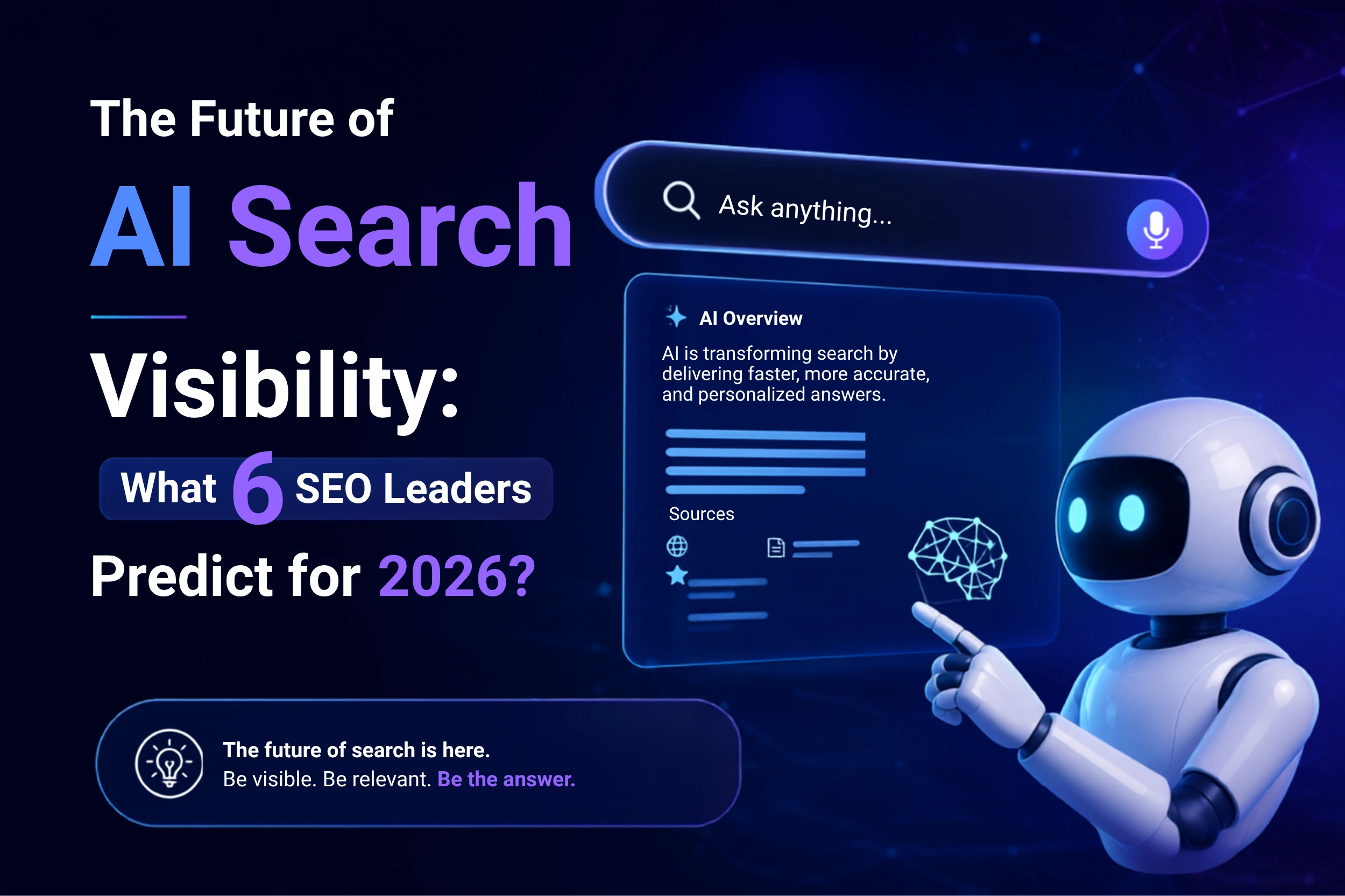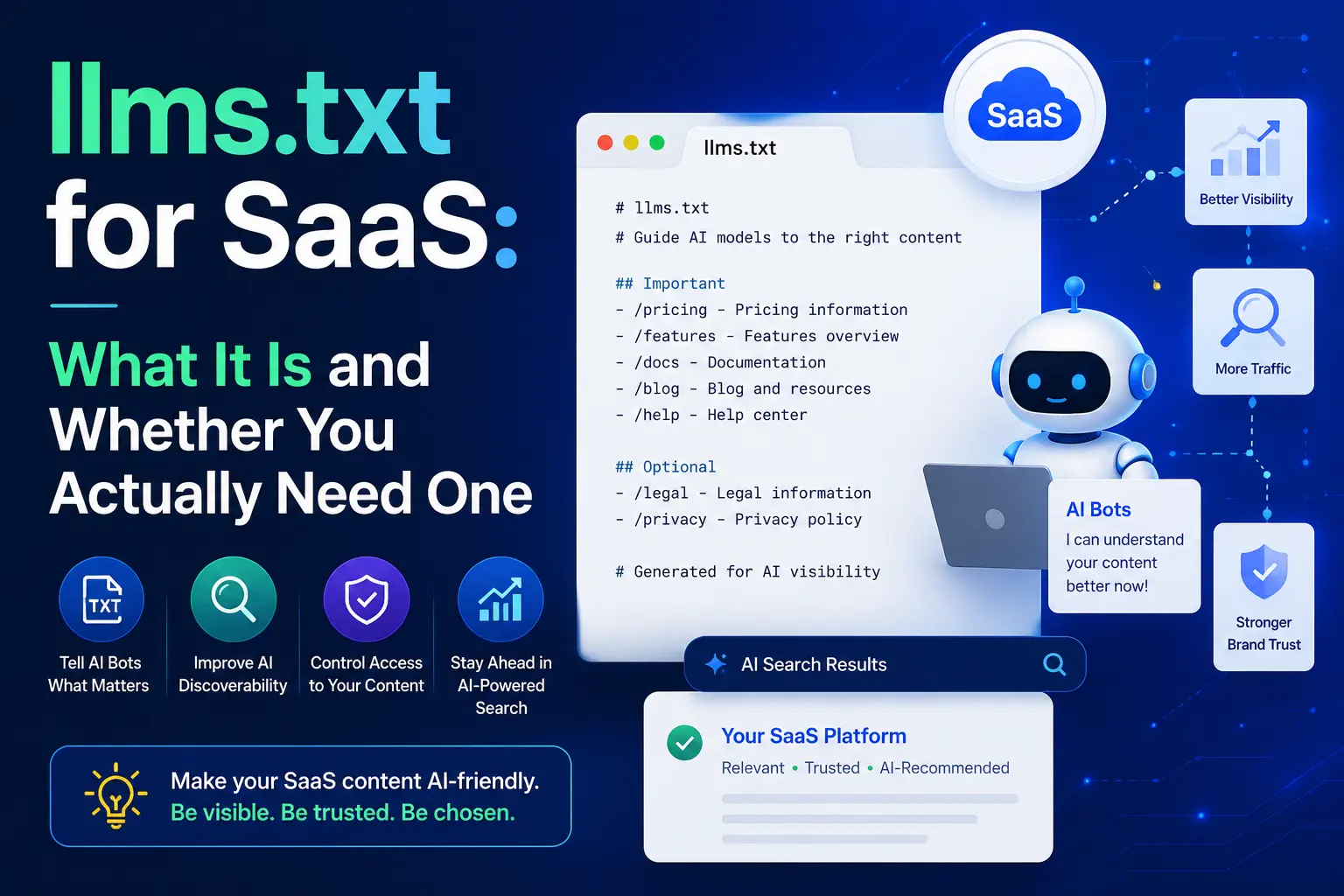
The discovery and evaluation of software products are being altered by the use of artificial intelligence. Platforms such as ChatGPT, Perplexity, Claude, and Google AI Overviews have been adopted by potential customers to seek software suggestions, relative tools, and respond to technical inquiries.
Key takeaways for llms.txt for SaaS:
- llms.txt helps AI systems discover important SaaS content through curated website resources.
- It complements robots.txt and sitemaps rather than replacing traditional technical SEO files.
- Major AI platforms have not confirmed widespread support for llms.txt yet.
- SaaS companies should prioritize quality content, accessibility, and technical SEO fundamentals first.
- Regular monitoring and updates are essential for maintaining an accurate llms.txt file.
The change has prompted software firms to consider methods of rendering their content more approachable to large language models (LLMs) to discover and understand. One proposed solution gaining attention is llms.txt for SaaS.
The concept is simple: create a Markdown file with links to most relevant resources of your site and place it in the root directory of your domain. This file may be used by AI systems to find product information, documentation, pricing pages, integrations and technical information.
However, major AI platforms have not confirmed widespread support for llms.txt. Writing the file does not give an advantage to achieving a higher rank of AI or appearance in databases.
Then, whether or not you really need a SaaS company? It depends on your web pages and data, the structure of your site, and documentation, as well as your overall AI search strategy.
What Is llms.txt?
llms.txt is a proposed web standard which aims to enable large language models to identify valuable content on websites.
The concept was introduced in 2024 by Jeremy Howard of Answer.AI.
The file is placed at:
yourdomain.com/llms.txt
It generally contains:
- A H1 heading with the name of the company or the product.
- A short description explaining the product.
- Sections organizing important resources.
- Links to documentation, product pages, pricing, and integrations.
- Short descriptions explaining each linked resource.
There is no aim of llms.txt for SaaS to list every URL. Rather, it provides an edited list of links to the resources that best describe the product and its features.
This may come in especially handy with SaaS websites that host hundreds of product pages, documentation websites, integrations and technical documentation websites.
Why Are SaaS Companies Interested in llms.txt?
SaaS websites can be complicated.
They include numerous documentation portals, API documentation, integration guides, documentation, release paths, product page, and support links.
Part of this information can also rely heavily on JavaScript or in the internals of the website architecture.
The possible advantage of llms.txt for SaaS is that it offers the simplification of the path of AI systems to authoritative material.
| SaaS Website Challenge | Potential Role of llms.txt |
| Hundreds or thousands of URLs | Highlights important resources |
| JavaScript-heavy documentation | Points toward accessible content |
| Complex website architecture | Creates a simplified content directory |
| Important pages buried deep in the site | Surfaces priority resources |
| Similar or duplicate information | Highlights preferred authoritative pages |
However, the file should never replace improvements to the website itself.
Poor documentation, outdated information, weak product pages, or issues with crawlability should be fixed, and then the benefits of llms.txt can be expected.
How Does llms.txt Work?
The new standard aims at assisting AI systems to locate the information on websites without any difficulties.
Its AI crawler might possibly find the file, interpret what resources the site owner considers important, and retrieve those pages when answering user questions.
A basic file might look like this:
# Example SaaS Platform
> A software platform that helps businesses manage customer communication.
## Documentation
- Getting Started Guide: Instructions for setting up the platform.
- API Documentation: Information about endpoints and authentication.
## Product
- Features: Overview of the platform’s capabilities.
- Pricing: Available subscription plans.
- Integrations: Supported third-party applications.
The success of llms.txt for SaaS is reliant on the choice of resources.
It is counterproductive to add hundreds of URLs. It should also be an edited set of authoritative and useful material in the file.
llms.txt vs. robots.txt vs. sitemap.xml
llms.txt is not a replacement to sitemap.xml or robots.txt.
Each file serves a different purpose.
| File | Main Purpose | Intended Audience | Format |
| robots.txt | Controls crawler access | Search and AI crawlers | Text directives |
| sitemap.xml | Lists important website URLs | Search engine crawlers | XML |
| llms.txt | Curates authoritative resources | AI systems (proposed) | Markdown |
Robots.txt sets rules on which crawlers will be able to access various sections of a site.
Sitemap.xml assists search engines to find the URLs that the owners of the web sites would like to be crawled and indexed.
The purpose of llms.txt for SaaS is different. It gives the AI systems a set of pages, which are most handy to explain the company, product, and technology.
Therefore, these files should be viewed as complementary rather than interchangeable.
Do AI Crawlers Actually Use llms.txt?
This is among the most critical questions to this proposed standard.
Major AI companies have not publicly confirmed widespread support for llms.txt.
Google has suggested that to feature in their AI search activity, no special AI-oriented files are necessary. OpenAI, Anthropic and Perplexity are also not officially stated to support the standard.
Thus, the introduction of the use of llms.txt for SaaS currently could be called an experimental optimization rather than a proven ranking strategy.
Nevertheless, the file is not very costly to maintain and generate.
Given the large scale documentation and websites of SaaS business, it can be considered a sensible method to prepare in the future advancements in AI content discovery.
Does Your SaaS Website Actually Need llms.txt?
Not every SaaS business should prioritize llms.txt.
This choice is determined by your web design, documentation ecosystem, technical assets and current search visibility.
| Consider Implementing llms.txt | Consider Deprioritizing It |
| You maintain extensive documentation | Your website contains only a few pages |
| Documentation relies heavily on JavaScript | Your content is already easy to crawl |
| Important resources are difficult to discover | Your website architecture is simple |
| Your brand appears in AI-generated answers | You have limited search visibility |
| You can automatically maintain the file | Implementation requires significant resources |
| You maintain API or developer documentation | Core content still needs improvement |
Experimentation may be more advantageous in large SaaS companies that have documentation portals, API references, integration libraries, and complex website structures.
Firstly, smaller SaaS businesses need to focus on content quality, technical SEO, product pages, documentation, internal linking and brand authority.
llms.txt has the capability of assisting AI systems uncover useful information, but it cannot turn weak content into authoritative information.
How to Create an Effective llms.txt File?
Creating llms.txt for SaaS does not require complicated development work. The greatest problem is the choice and arrangement of the appropriate resources.
1. Write a Clear Product Description
Start with a concise description explaining:
- What the software does.
- Who the product serves.
- The primary problem it solves.
- The industry or category it operates within.
Avoid exaggerated marketing claims. This is aimed at creating a descriptive context.
2. Include Only Important Pages
The file must indicate trustworthy sources and not all the website URLs.
Consider including:
- Product overview pages.
- Core feature pages.
- Documentation.
- Getting-started guides.
- API references.
- Pricing information.
- Integration directories.
- Security and compliance pages.
- Product comparisons.
- Changelogs.
The objective is relevance, not volume.
3. Add Descriptions to Links
Every link should contain a short explanation.
For example:
- API Documentation: REST API endpoints, authentication methods, and implementation guides.
Descriptions add more context and make it possible to distinguish between llms.txt and a traditional sitemap.
4. Use Accessible Resources
Wherever feasible, point toward pages containing clean HTML or Markdown content.
In case your documentation is based on client-side JavaScript, or even a large part of it, see whether you can provide accessible alternatives to critical resources.
Content that is easy to retrieve and understand is more beneficial to search engines and artificial intelligence (AI) systems.
5. Keep the File Updated
The file can reduce the usefulness by the outdated documentation, the price data or unsupported functionalities.
Periodically review llms.txt when there are major changes of the product.
Large SaaS businesses should consider automatically generating and maintaining the file.
What Is llms-full.txt?
llms-full.txt is another proposed component of the standard.
Although, llms.txt gives links to some valuable resources of websites, llms-full.txt may contain the actual content of those resources.
This may enable AI systems to provide access to extensive product data through a single request.
However, SaaS products change frequently.
Features are launched, APIs are modified, integrations are introduced, and pricing structures change.
That is why, companies should implement llms-full.txt only when the generation and updating process can be automated.
Manually maintaining large amounts of product content could result in outdated information.
Can llms.txt Improve AI Search Visibility?
Creating llms.txt for SaaS will not automatically enhance rankings and ensure citations by different AI-based platforms.
The visibility of AI searches lies on larger factors, including:
- Clear and well-structured content.
- Comprehensive product documentation.
- Original research and first-party information.
- Strong brand authority.
- Mentions on trusted third-party websites.
- Technical accessibility.
- Consistent product information.
- Useful comparison and alternative pages.
llms.txt must thus remain as a supporting technical component, rather than a complete AI optimization strategy.
Search visibility continues to be based on strong, authoritative content.
How Can You Measure Whether llms.txt Is Working?
The effect of llms.txt for SaaS may not be easy to measure since the file does not have analytics or ranking reports.
Businesses must monitor indirect signals.
1. Analyze Server Logs
Ensure whether AI crawlers are requesting the /llms.txt file.
Some of the potential user agents are GPTBot, ClaudeBot, PerplexityBot as well as Google-Extended.
Access is verified by crawler activity but does not indicate that the file influenced an AI-generated response.
2. Monitor AI Search Visibility
Monitor your company’s visibility on key prompts, such as:
- Software recommendation queries.
- Product comparison searches.
- Alternative software queries.
- Industry-specific tool recommendations.
- Integration questions.
- Technical product queries.
Regular mentions across multiple prompts give deeper insights compared to occasional citations.
3. Track Business Outcomes
Finally, AI visibility ought to lead to business outcomes.
Track branded searches, direct traffic, AI referral traffic, product signups, qualified leads and demo requests.
These signals are a more valuable representation of your overall AI search visibility & performance.
Common Mistakes to Avoid
Several mistakes can reduce the usefulness of llms.txt for SaaS.
To begin with, avoid using it as an AI ranking shortcut. Technical files cannot compensate for weak content or poor documentation.
Second, do not include hundreds of URLs. The file must be kept curated.
Third, avoid linking to outdated, inaccessible, or low-quality pages.
Fourth, keep investing in technical SEO fundamentals like crawlability, internal linking, XML sitemaps, website architecture, and content quality.
Finally, avoid manually maintaining llms-full.txt when your product changes frequently.
The Future of llms.txt and AI Search
The process of AI-based search is still on development.
Search engines, conversational assistants, and autonomous AI agents are creating new mechanisms of finding and processing website information.
Standardized resources such as llms.txt could eventually help website owners communicate important content directly to AI systems.
Nevertheless, it is not sure that it will be widely adopted.
It is most advantageous to see llms.txt as a low-cost experiment in the context of a larger search program.
Improve your content. Strengthen technical SEO. Maintain accessible documentation. Build brand authority. Provide clear responses to customer enquires.
Then use llms.txt as an additional method of helping AI systems discover your strongest resources.
Build an AI-Ready SaaS Website With Aarav Tech Services
Implementing llms.txt for SaaS can help businesses prepare for AI-powered search, especially companies with complex websites, extensive documentation, or JavaScript-heavy platforms. Nevertheless, the trick of llms.txt is not sufficient to make AI more visible. To be successful, it needs technical SEO, authority content, accessible architecture, proper documentation, AI search optimization, and constant monitoring.
We at Aarav Tech Services, can assist SaaS companies with increasing their visibility in search engines and probable AI platforms. We offer technical optimization, content strategy, site development, AI preparedness and overall seo professional services that approach sustainable growth. We develop tailor-made measures to boost your website, content and the entire digital performance with future search prospects. Ready to improve your website’s search visibility and prepare for the future of AI-powered discovery? Contact us today.